
In a single-cylinder engine, then no firing order is needed because the ignition timing is set just before the piston reaches Top Dead Center (TDC) on the compression stroke. However, in a multi-cylinder engine (3, 4, 6 cylinders or more), this firing order becomes very important.
Incorrectly placing the ignition timing on the piston stroke can cause problems in the engine such as engine vibrations becoming too strong, unbalanced, and lack of power.
In addition, Firing Order can also be used to help us in determining valve clearance settings, valves or valves. For more details, please read the article How to determine valve clearance settings based on Firing Order that Ombro has previously posted on this blog.

The firing order in this car engine is very diverse, depending on the engine design used and the number of cylinders used. For example, for a 4-cylinder engine, there are at least 4 firing order models, namely 1-3-4-2, 1-2-4-3, 1-3-2-4, 1-4-3-2. While for a 6-cylinder engine, there are at least 10 firing order models ranging from 1-5-3-6-2-4,
1-4-3-6-2-5, ..., to 1-4-2-6-3-5.
Currently, the firing order 1-3-4-2 (for 4-cylinder engines) and firing order 1-5-3-6-2-4 (for 6-cylinder engines) are firing orders that are quite widely used in cars in Indonesia.
Well, in this article, ombro will share information about Firing Order 1-3-4-2 on a 4-cylinder engine only as an example of discussion.
Firing Order 1-3-4-2
Firing Order 1-3-4-2 indicates that the ignition timing sequence will start from cylinder 1, then to cylinder 3, cylinder 4, and finally cylinder 2. After the ignition reaches cylinder no. 2, the ignition will return to cylinder no. 1 again and so on. This sequence is determined based on the piston work stroke that occurs in the engine.
This condition is of course also influenced by the crankshaft design in a 4-cylinder engine which generally has a design where pistons no. 1 and no. 4 move in the opposite direction to pistons no. 2 and 3. If pistons 1 and 4 are in the top position, then pistons 2 and 3 are in the bottom position. See the example in the image below.

This design significantly influences the precise ignition timing of each cylinder, creating the now widely used 1-3-4-2 firing order. Therefore, the ignition timing (firing order) is determined so that the four-stroke engine cycle can occur perfectly in all four cylinders.
Now, observe the spark plug firing time in the image below.

The image above shows a single piston cycle in a single cylinder. The image shows the spark plug firing just before the piston reaches Top Dead Center (TDC).
The spark plug firing as the compression stroke approaches TDC is the ideal timing for the engine to achieve optimal power output. This also applies to the other three cylinders in a four-cylinder engine.
Also read:
- How a gasoline engine works
- Components and how a conventional car ignition system works
- Functions of car distributors and their components
- How to set the rpm of an injection car
Pay attention to the table below which will show the ignition timing and piston stroke in each cylinder.
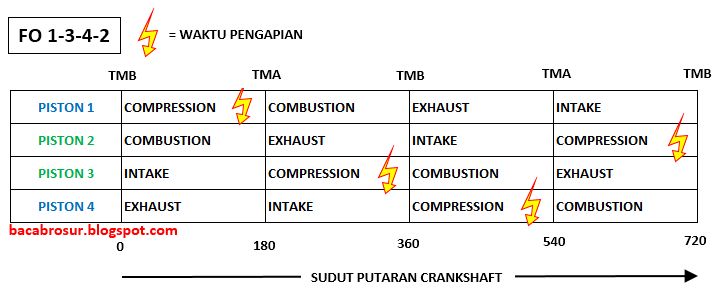
From the image above, we can see that the engine rotation will flow to form an ignition timing that matches the piston stroke starting from cylinder 1 - cylinder 3 - cylinder 4 - cylinder 2, so the engine can rotate smoothly. Here's an animation example of a 1-3-4-2 firing order.

With the 1-3-4-2 firing order setting, the piston strokes in each cylinder do not collide, allowing the power generated by each cylinder in the engine to flow smoothly, making the engine rotation more comfortable and stable.
This concludes our article on the 1342 firing order in gasoline engines. We hope it's helpful.